What Is a Digital Health Engagement Platform and Who Needs One?
August 13, 2026

The term "digital health engagement platform" gets used broadly, sometimes to describe a wellness app, sometimes a care management tool, and sometimes a full population health management system.
The ambiguity makes it harder for health plans, employers, and wellness vendors to evaluate what they actually need.
This guide cuts through the noise. Here is what a digital health engagement platform actually is, who needs one, and what separates a platform that drives real outcomes from one that just generates data.
What Is a Digital Health Engagement Platform?

A digital health engagement platform is a technology solution designed to connect individuals to health programs and resources and to give organizations the tools to reach, motivate, and sustain that engagement at scale.
Unlike standalone wellness apps, a health engagement platform integrates multiple capabilities into a single system, combining health assessments, incentive programs, health coaching, communications, and reporting into a coordinated program delivery infrastructure.
The defining characteristic of a true digital health platform is not the features it offers; it is the outcomes it enables.
Participation without behavior change is not engagement. Engagement that does not connect to health improvement is not value.
Who Needs a Digital Health Engagement Platform?

Not every organization needs the same type of platform, but several types of organizations consistently benefit from a structured digital health engagement solution.
Health Plans
Health plans managing Medicare Advantage, D-SNP, Medicaid, and Commercial populations need a member engagement platform that can reach diverse member segments through multiple channels while connecting engagement data to care gap closure, quality measure performance, and HEDIS reporting.
For health plans, a digital health engagement platform is not a wellness benefit; it is a quality improvement infrastructure.
Large Employers
Large employers need a health engagement platform that drives workforce participation in wellness programs, connects health data to incentive management, and gives HR and benefits teams real-time visibility into population health trends.
For employers managing thousands of employees across multiple locations or business units, a platform that personalizes outreach and tracks outcomes at scale is essential for demonstrating ROI.
Wellness Service Providers
Wellness vendors and third-party administrators need a digital health platform that can be configured for multiple clients, with white-label branding, flexible program design, and the ability to manage distinct populations under one system.
For wellness service providers, the platform is not just a delivery tool; it is the foundation of their service offering.
What Separates a Useful Digital Health Engagement Platform from a Basic Wellness App
The difference between a wellness app and a digital health engagement platform is not cosmetic; it is structural.
Here is what distinguishes a platform built for population health engagement from a consumer tool dressed up for enterprise use:
- Multi-channel delivery: A platform reaches members through digital, phone, and paper outreach. A wellness app reaches members who already use the app.
- Health assessment integration: A platform connects assessment data to personalized program recommendations and follow-up actions. An app collects self-reported data with no clinical backbone.
- Incentive management: A platform automates reward programs tied to specific health actions and tracks fulfillment across the population. An app offers points for logging steps.
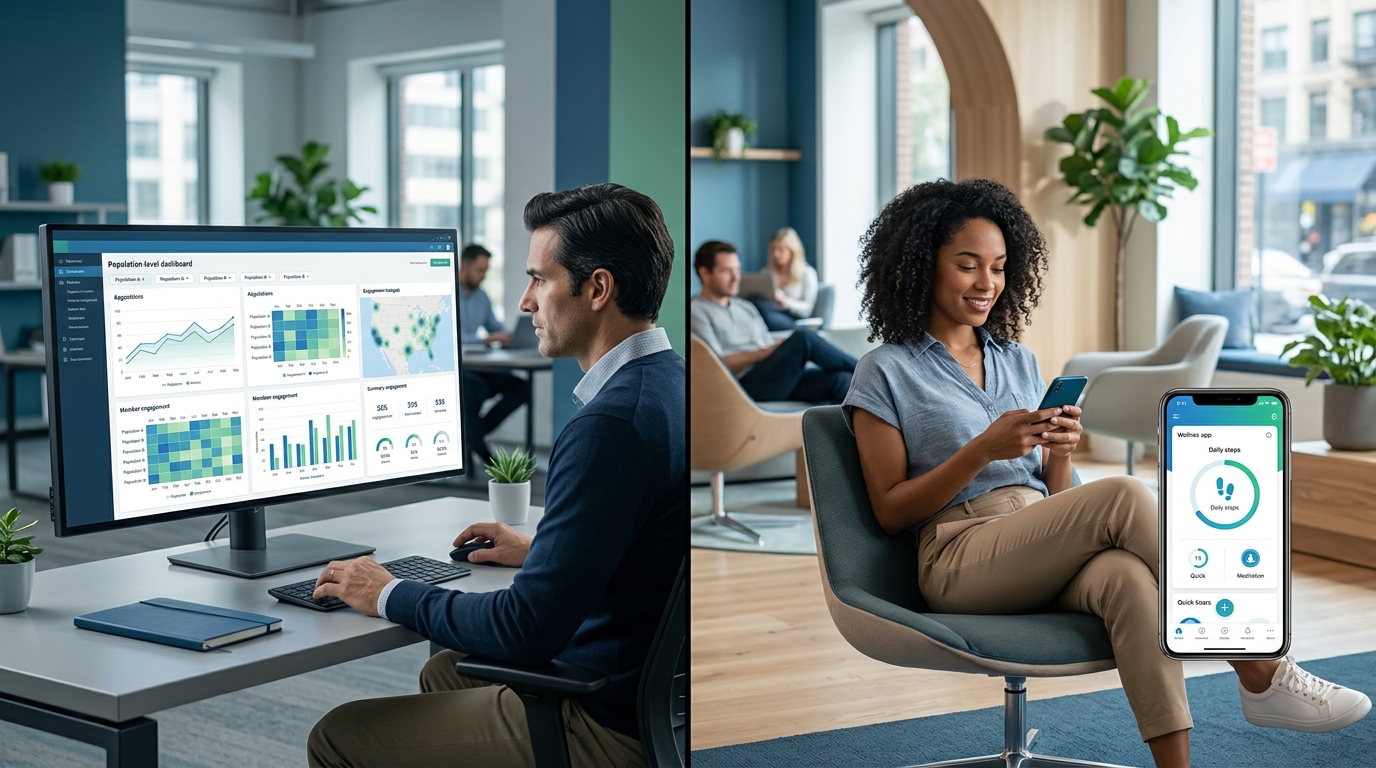
- Population-level reporting: A platform gives administrators real-time visibility into participation, risk stratification, care gap status, and program performance. An app shows individual progress.
- Compliance credentials: A platform carries HITRUST, SOC 2, and NCQA certifications. An app may not have any independent security validation.
Key Capabilities to Look for in a Digital Health Engagement Platform

When evaluating a digital health engagement platform, health plans, employers, and wellness vendors should prioritize the following capabilities:
Multi-Channel Member Outreach
Population health engagement requires meeting members where they are, not just where it is convenient.
Platforms that support digital, phone, and paper outreach consistently achieve higher participation rates than digital-only solutions, particularly for Medicare Advantage, dual-eligible, and Medicaid populations where digital access cannot be assumed.
Configurable Health Assessments
A digital health engagement platform should include clinically validated health assessments that connect member health data to personalized program recommendations, care gap alerts, and coaching referrals.
For health plans, NCQA-certified health assessments are essential for meeting quality and compliance standards.
Incentive and Rewards Management
Incentives are one of the most proven drivers of health engagement.
The best platforms allow organizations to configure earning rules, reward types, and redemption options by population segment or line of business, and automate fulfillment so administrators are not managing rewards manually.
White-Label and Multi-Client Configuration
For health plans and wellness vendors, the platform should be fully configurable as a branded experience, with the ability to manage distinct client populations, program designs, and reporting structures from a single system.
How PDHI Delivers Digital Health Engagement at Scale
PDHI's platform is built for the organizations that need population health engagement most:
We work with health plans that manage Medicare Advantage, D-SNP, Medicaid, and commercial populations.
We also support wellness service providers with multiple clients and large employers with diverse teams.
Its multi-channel delivery, NCQA-certified health assessments, configurable incentive programs, health coaching tools, and 55+ self-service reports give administrators everything they need to reach every member, drive meaningful participation, and measure outcomes at scale.
PDHI is a fully white-labeled platform with HITRUST r2 Certification since 2015 and SOC 2 Type 2 certification.
We help health plans and wellness vendors meet compliance needs and offer flexible branding, so they can deliver trusted, high-quality wellness programs under their own name.
Final Thoughts
A digital health engagement platform is not a wellness perk; it is a population health infrastructure investment.
For health plans, it is how quality improvement goals get operationalized at the member level.
For employers, it is how wellness program ROI gets demonstrated beyond participation counts.
For wellness vendors, it is the foundation on which their service offering is built.
Ready to see what a purpose-built digital health engagement platform looks like in action?
Request a demo and explore how PDHI drives population health engagement at scale.
Frequently Asked Questions
1. What is a digital health engagement platform?
A digital health engagement platform is a technology solution that connects individuals to health programs, resources, and support, and gives organizations the tools to reach, motivate, and sustain engagement at scale.
2. Who needs a digital health engagement platform?
Health plans, large employers, and wellness service providers are the primary users of digital health engagement platforms. Health plans need them to drive member engagement and close care gaps.
Employers need them to manage workforce wellness programs at scale. Wellness vendors need them to deliver branded, configurable programs across multiple clients.
3. What is the difference between a wellness app and a digital health engagement platform?
A wellness app is a consumer tool designed for individual use.
A digital health engagement platform is an enterprise solution built for administrators managing large populations, with multi-channel outreach, population-level reporting, compliance certifications, and integration with health assessments, incentives, and coaching tools that wellness apps cannot match.
4. What compliance certifications should a digital health engagement platform have?
For health plans and regulated employers, the minimum standard is HITRUST r2 Certification and SOC 2 Type 2.
Organizations subject to NCQA, HEDIS, or CMS reporting requirements should also look for platforms with NCQA-certified health assessments and self-management tools, certifications that validate the clinical quality of the platform's content, not just its security controls.