White-Label Wellness Platform vs. Employee Wellness App
September 16, 2026
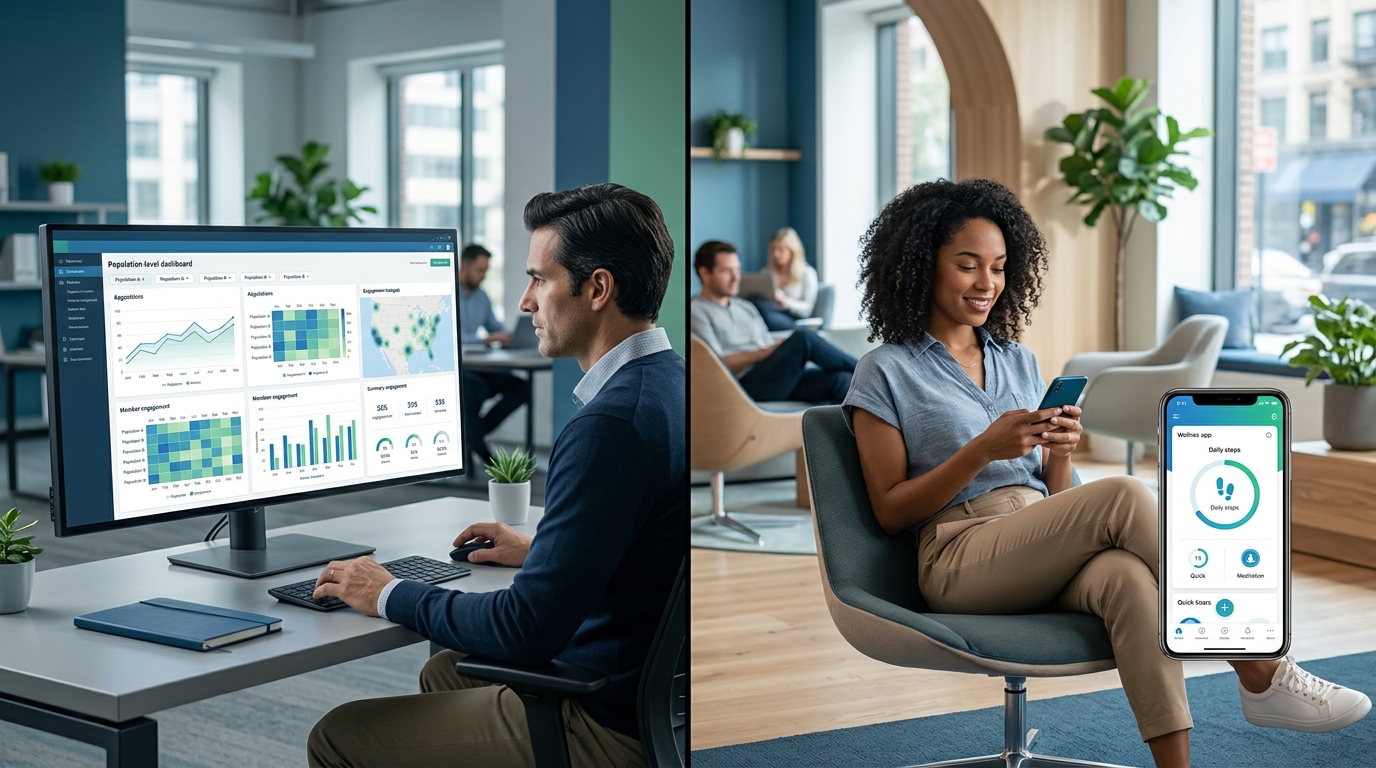
The terms "white-label wellness platform" and "employee wellness app" are often used interchangeably, but they describe fundamentally different solutions built for fundamentally different needs.
Choosing the wrong one does not just create technology problems.
It creates program problems that show up in participation rates, compliance reporting, and member outcomes.
Here is how to tell which one your organization actually needs, based on three questions that cut through the feature comparison noise.
What is the Difference Between a White-Label Wellness Platform and an Employee Wellness App?
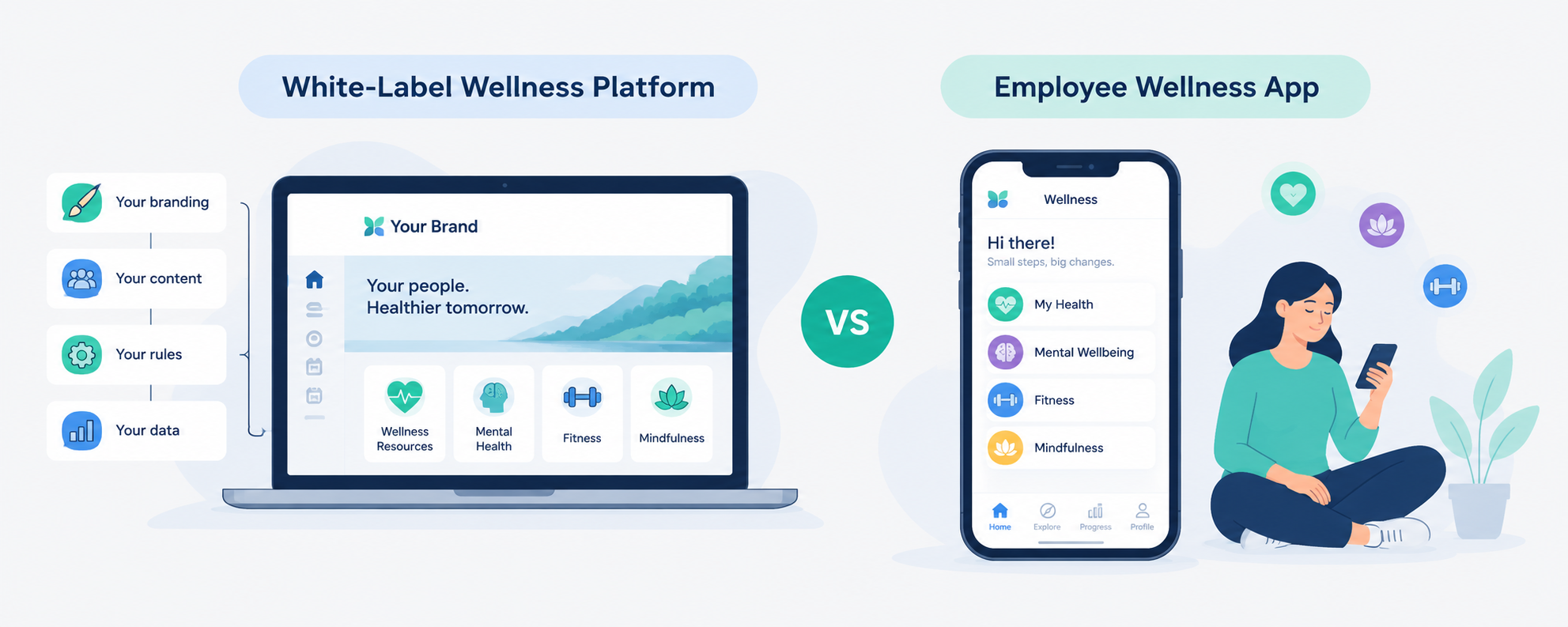
An employee wellness app is a consumer-grade digital tool designed for individual use.
It typically focuses on one or two wellness dimensions (step tracking, meditation, nutrition logging) and delivers a standardized experience that looks and functions the same for every user.
It is built for personal engagement, not population management.
A white-label wellness platform is a business solution that lets organizations like health plans, wellness vendors, and large employers offer health and wellness programs under their own brand for a wide range of people.
The platform brings together health assessments, incentive management, health coaching, biometric screening data, and population-level reporting in one flexible system.
Every part that members see uses the organization’s own branding.
The Comparison at a Glance
Three Questions to Help You Decide
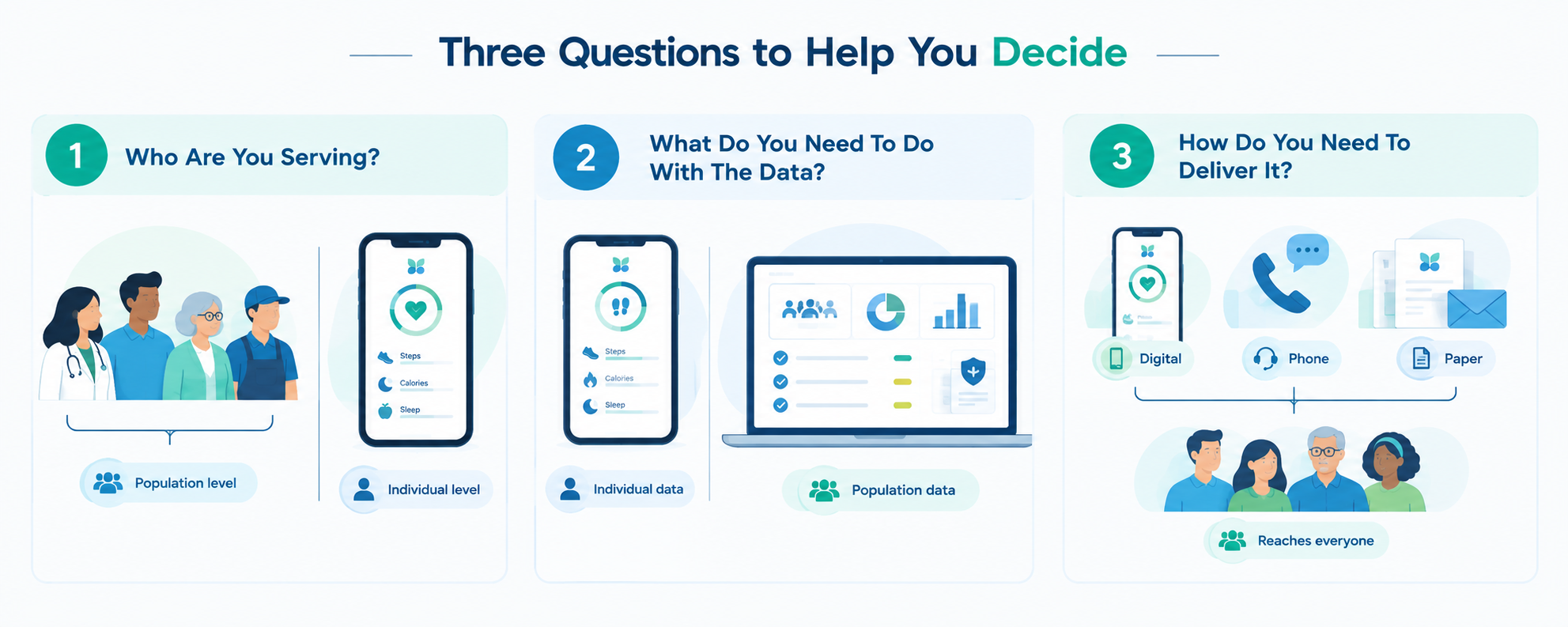
1. Who Are You Serving?
If you are managing a defined member or employee population, and you are responsible for their health outcomes, compliance metrics, or quality scores, you need a white-label wellness platform.
The moment you are accountable for population-level results, a consumer app stops being a solution and starts being a liability.
If your goal is simply to give individual employees a tool to support their personal wellness journey, with no population-level reporting requirement, a wellness app may be sufficient.
2. What Do You Need To Do With The Data?
Employee wellness apps generate individual data (steps taken, calories logged, sleep tracked). That data lives in the app and serves the individual user.
White-label wellness platforms generate population data, completion rates, risk stratification, care gap status, incentive redemption, and HEDIS-relevant metrics.
That data lives in a reporting system that gives program administrators the visibility to act on it.
If your organization needs to report on program performance, demonstrate ROI, or connect wellness data to quality improvement goals, a wellness app cannot deliver what you need.
3. How Do You Need to Deliver It?
Wellness apps are digital-only; they reach members who download and use an app. For most working-age, digitally-engaged employee populations, that is workable.
But for health plans managing Medicare Advantage, D-SNP, Medicaid, or Commercial populations, or for employers with deskless, hourly, or older workforces, digital-only delivery consistently leaves a significant portion of the population unreached.
White-label wellness platforms that support digital, SMS, and paper outreach close that gap.
A program that only reaches 60% of its target population because the other 40% do not use apps is not a wellness program; it is a wellness benefit for the already-engaged.
When a Wellness App is The Right Choice
Wellness apps work well for boosting engagement, offering digitally-active employees an easy way to build healthy habits outside of a formal wellness program.
These apps are especially useful as part of a larger wellness plan, mainly for younger, mobile-focused employees who are likely to use them.
In these cases, the main goal is to encourage engagement, not just compliance or managing overall health.
When a White-Label Wellness Platform is The Right Choice
A white-label wellness platform is the right choice when your organization is accountable for population health outcomes, not just individual engagement.
Health plans that need NCQA-certified health assessments, HEDIS-aligned reporting, and multi-channel member outreach need a platform, not an app.
Wellness vendors that manage programs for multiple employer clients need a configurable, brandable system, not a consumer tool.
Large employers that need to demonstrate wellness program ROI to leadership need population-level data.
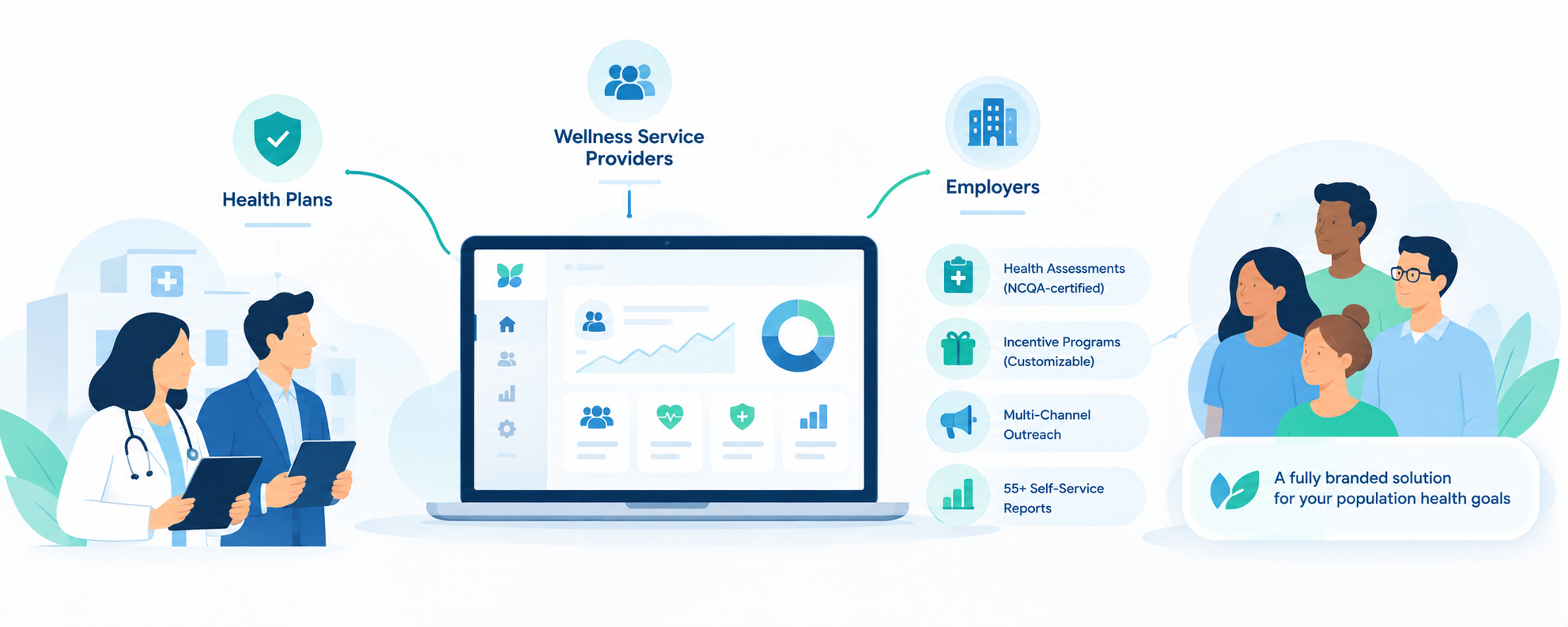
PDHI’s white-label wellness platform is designed for organizations that want a fully branded solution.
It brings together NCQA-certified health assessments, customizable incentive programs, multi-channel outreach, and over 55 self-service reports.
For health plans, wellness service providers, and employers that need more than an app, PDHI delivers the infrastructure to manage population health at scale.
Conclusion
White-label wellness platform vs. employee wellness app is less about technology and more about accountability. What are you responsible for delivering, and to whom?
If the answer involves population health outcomes, compliance reporting, or managing a diverse member population at scale: the answer is a white-label wellness platform.
If the answer is supplemental engagement for a digitally-active workforce: a wellness app may be all you need.
Ready to see what a purpose-built white-label wellness platform looks like in practice?
Request a demo and explore how PDHI supports population health at scale.
Frequently Asked Questions
Here are the most common questions organizations ask when deciding between a white-label wellness platform and an employee wellness app.
1. What is a white-label wellness platform?
A white-label wellness platform is an enterprise wellness solution that organizations use with their own branding.
It includes features like health assessments, incentive management, multi-channel outreach, and population-level reporting.
Unlike consumer wellness apps, these platforms are made for administrators who manage large, diverse groups, not for individuals tracking their own health goals.
2. Can an employee wellness app replace a white-label wellness platform?
For most health plans, wellness vendors, and large employers, the answer is no.
Employee wellness apps can show individual engagement data, but they do not offer population-level reporting, NCQA-certified health assessments, flexible incentive management, or multi-channel outreach to hard-to-reach groups.
3. What compliance certifications should a white-label wellness platform have?
For health plans and regulated employers, the minimum standard is HITRUST r2 Certification and SOC 2 Type 2.
If your organization needs to meet HEDIS or CMS reporting requirements, you should also look for NCQA-certified health assessments.
These certifications show that the clinical content is high quality, not just that the data is secure.
4. How is PDHI different from an employee wellness app?
PDHI is a white-label wellness platform, not a consumer app.
It is made for health plans, wellness vendors, and large employers who need NCQA-certified health assessments, flexible incentives, multi-channel outreach by digital, SMS, and paper, and population-level reporting.
It is built for administrators managing groups, not for individuals tracking their own goals.